
Diagonal Cracking and Hidden Drainage Defects: Why a Crack in the Wall Often Starts Below Ground
- Ricky Savage

- Jun 7
- 9 min read

When buyers spot a crack running diagonally across the brickwork of a property they are hoping to purchase, the immediate assumption is often the worst: subsidence, structural failure, a building that is slowly falling apart. In reality, diagonal cracking is one of the most common defects we record during a survey, and in the great majority of cases the underlying cause is far more manageable than it first appears. The difficulty is that the crack you can see is rarely the whole story. The true cause frequently lies out of sight, below ground, in the drainage system serving the property and this post is about hidden drainage defects..
At Skyline Property Surveys, we see this pattern regularly across older homes throughout East Yorkshire and North Yorkshire. A diagonal crack appears, the homeowner repoints it, and within a year or two it returns. The reason is simple: the repair addressed the symptom rather than the source. This article explains what diagonal cracking can tell us, why drains are so often involved, and why we so frequently recommend a CCTV drain survey before anyone makes a legal commitment to purchase.
What diagonal cracking is telling you
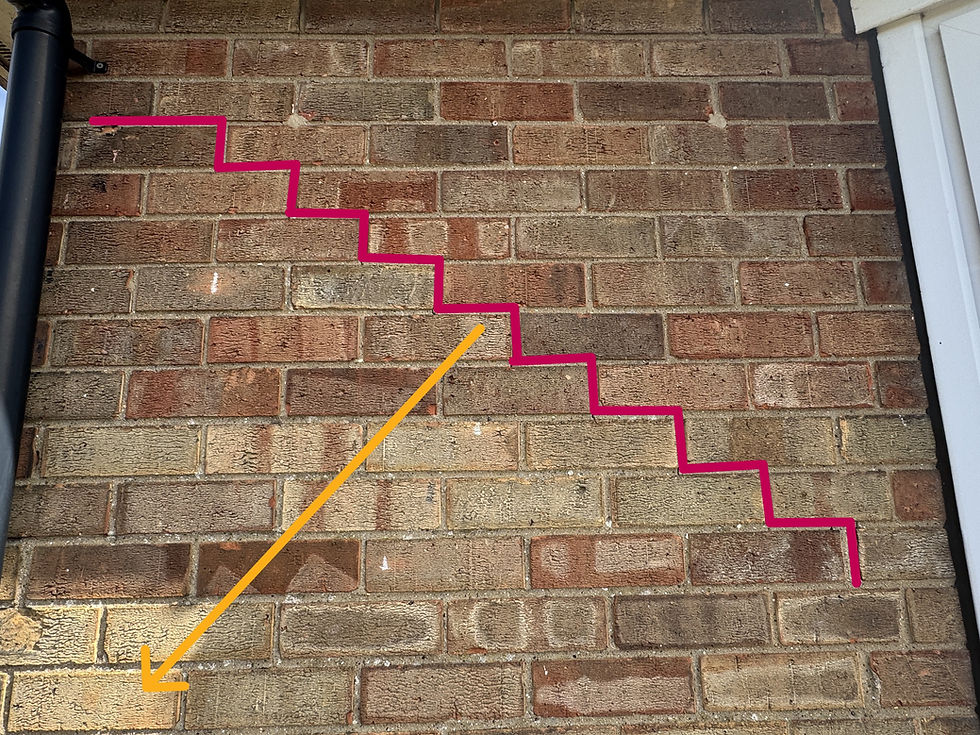
Brickwork is strong in compression but has very little tolerance for movement. When the ground beneath a wall shifts, even slightly, the masonry has to go somewhere, and it relieves that stress along the lines of least resistance, typically the mortar joints. The result is the characteristic stepped or diagonal crack that follows the bedding and perpend joints up through the wall.
The orientation, width and location of a crack all carry information. Fine diagonal cracking of around 1 to 2mm, particularly close to openings such as bay windows or door reveals, usually indicates minor, localised movement rather than wholesale structural failure. Cracking that is wider, that is progressive, or that is tapering, opening more at the top than the bottom, warrants closer attention. As surveyors, we record the dimensions, note whether the crack is live or historic, and consider its position relative to other features of the building, including drainage runs, trees, and changes in ground level.
A crack that follows the mortar joints in this stepped pattern is a strong clue in itself. Because the joints are the weakest path through the masonry, the crack reveals the direction in which the wall is being pulled, and that direction often points back toward the source of the movement, whether that is a settling corner, a nearby tree, or a defective drain disturbing the ground below.
What matters most is the cause. A crack is not a defect in itself so much as evidence of a process, and the appropriate repair depends entirely on understanding what is driving the movement. Cutting out and repointing a crack, or even crack stitching to reinforce it, will only provide a lasting solution if the source of the movement has first been identified and addressed.
A real example: "The inspection chamber looked fine"

If a crack points us toward the drains, the natural next step is to look at the drainage system, and here there is an important limitation worth understanding. The photograph below shows a traditional brick inspection chamber recorded during a recent survey. It is in sound, serviceable condition: the brickwork and benching are intact, the clay channel is clean and undamaged, and the system was flowing freely on the day. There was no defect here at all.
And yet a chamber like this, reassuring as it looks, reveals only a very small fraction of the total drainage system. An inspection chamber is simply one access point on a network that may run for many metres beneath the garden, the driveway and the foundations, turning through bends and junctions before connecting to the public sewer. What we can actually see at the chamber is little more than the short length of channel directly beneath the cover. The overwhelming majority of the pipework, including the buried runs where displaced joints, cracks and root ingress most commonly develop, lies concealed and entirely out of view.
This is the crucial point for any buyer. A clean bill of health at the inspection chamber is genuinely good news, but it is not evidence that the rest of the system is sound. The defects that disturb the ground and contribute to cracking almost always sit in the concealed sections that no visual inspection can reach. It is precisely because so little of the system is visible, even when what we can see is perfectly serviceable, that we so often recommend a CCTV drain survey to examine the full length of the runs.
Why drains are so often the culprit
One of the most frequent contributors to localised ground movement is a defective underground drain. It is also one of the most overlooked, precisely because it cannot be seen.
When a buried drainage pipe develops a fault, water escaping from the system saturates the surrounding ground. In certain soil types this softening leads to a loss of bearing capacity beneath nearby foundations, and the wall above responds by cracking. In other situations, the escaping water washes away fine particles from the soil over time, creating voids that allow the ground to settle. Either way, the movement tends to be localised to the area around the drainage defect, which is exactly why we pay close attention when diagonal cracking appears in a wall that happens to sit close to a known drain run.
The link runs in both directions, too. Movement in a wall or in the ground can itself fracture a rigid drainage pipe, and once a pipe is cracked, the cycle of water escape and further ground disturbance accelerates. This is why, where we observe diagonal cracking with a plausible drainage connection, we treat the matter as one requiring proper investigation rather than guesswork.
Clay pipes, root ingress, displaced joints and hidden drainage defects

A great many of the properties we survey were built before the widespread adoption of modern plastic drainage, and their below-ground systems are formed from vitrified clay pipework, often laid in relatively short sections with rigid joints. Clay is a durable material and many of these systems have performed well for decades. However, they are vulnerable to two related problems that we encounter time and again.
The first is displaced or open joints. Clay drainage relies on the integrity of the joints between pipe sections. Ground movement, settlement, vibration from nearby traffic, or simple age can cause these joints to open or step out of alignment. Once a joint is displaced, it becomes a point at which water can escape into the surrounding ground and at which debris can collect, restricting flow and increasing the likelihood of blockages.
The second, and closely connected, problem is root ingress. Tree and shrub roots are drawn to the moisture and nutrients within a drainage system, and even a hairline opening at a displaced joint provides an entry point. Roots work their way in, then expand as they grow, widening the gap, displacing the pipe further, and eventually forming dense root masses that obstruct the bore of the pipe entirely. The result is a self-reinforcing defect: roots open the joint, the open joint admits more water and more roots, and the disturbance to the ground around the pipe grows. The escaping water and the physical disruption can both contribute to the ground movement that ultimately shows itself as cracking in the wall above.
Crucially, none of this is visible from the surface. A drain run may look perfectly serviceable from an inspection chamber, with water flowing freely on the day of inspection, while a significant joint displacement or a developing root mass sits just a few metres away in a section of pipe that no visual inspection can reach.
Why we recommend a CCTV drain survey

This is the heart of the matter. A standard home survey, including the RICS Home Survey Level 3, is a careful and thorough visual inspection, but it cannot see inside buried pipework. We assess drainage by inspecting accessible inspection chambers and by observing flow, but the majority of any below-ground system remains concealed. Where we identify diagonal cracking that may be linked to drainage, the responsible course is to recommend specialist further investigation rather than to speculate about a cause we cannot confirm.
A CCTV drain survey is the appropriate tool. A drainage specialist passes a camera through the system to inspect the condition of the pipework along its full length. This reveals displaced joints, cracked or fractured sections, root ingress, blockages, and any structural defects in the runs, and it allows the layout of the system to be mapped. Armed with that information, the true cause of movement can be confirmed or ruled out, and any remedial work, whether localised repair, relining, or replacement, can be properly specified and costed.
This is the part of the system that no visual inspection from a chamber can ever reach. A pipe like the one above might be carrying flow perfectly well on the day of inspection, yet the cracks along its length are steadily allowing water to escape into the ground and providing the openings through which roots will eventually find their way in. Only a camera passed along the run will show it.
Our consistent advice is that this investigation should be carried out before making a legal commitment to purchase the property. The cost of a CCTV survey is modest set against the cost of remedial drainage works and associated repairs, and it allows our clients to proceed with a clear understanding of the financial implications. Where appropriate, we also recommend that vegetation is cut back from walls and drainage runs, and that formal quotations are obtained from suitably qualified contractors so that the buyer is fully informed.
A measured, not alarmist, approach
It is worth emphasising that the presence of a diagonal crack and a recommendation for a drain survey does not mean a property should be avoided. Many of the homes where we make this recommendation are perfectly sound purchases once the issue is understood and addressed in a planned manner. Our role is to give buyers the clearest possible picture of a property's condition, to identify where a defect's true cause lies below the surface, and to point them toward the right specialist investigation so that they can make a reasoned and informed decision. That is precisely what the further-investigation recommendations in our reports are designed to achieve.
This is where the real skill of a surveyor lies. It is rarely about one dramatic defect; far more often, it is about noticing the small things, a hairline crack here, a slight change in level there, a drain run in the wrong place, and piecing those individual fragments of evidence together. Each on its own may mean very little, but read collectively they point toward a logical conclusion, allowing us to explain the likely cause and to advise you clearly on the real risk and what to do about it.
What our clients say
We take a great deal of pride in explaining our findings clearly and in being available to talk things through, because a survey is only useful if the person relying on it understands what it means for them. We were delighted to receive the following five-star Google review from a recent client:
"Ricky was professional and approachable throughout the surveying process and was always happy to talk through any concerns we raised. It was a pleasure dealing with Ricky and we would highly recommend him."
Feedback of this kind matters to us. Buying a home is one of the largest financial decisions most people will ever make, and our aim is always to combine technical rigour with genuine, approachable advice.
Talk to us about your survey
If you are buying a property and have noticed cracking, are concerned about older clay drainage, or simply want the reassurance of a thorough, independent assessment, we would be glad to help. We aim to make the whole process as simple and straightforward as possible.
To find out more about what is included, please visit our Home Buyer Survey page, and to get an immediate quote, please visit our Book a Survey page, where you can see our live availability and book in straight away. Thank you for taking the time to read our most recent blog post! Best wishes
Ricky Savage


Comments