
Why Period Homes Must Stay Vapour Permeable: Lessons from a Recent Level 3 - Building Survey

Updated: Jun 24
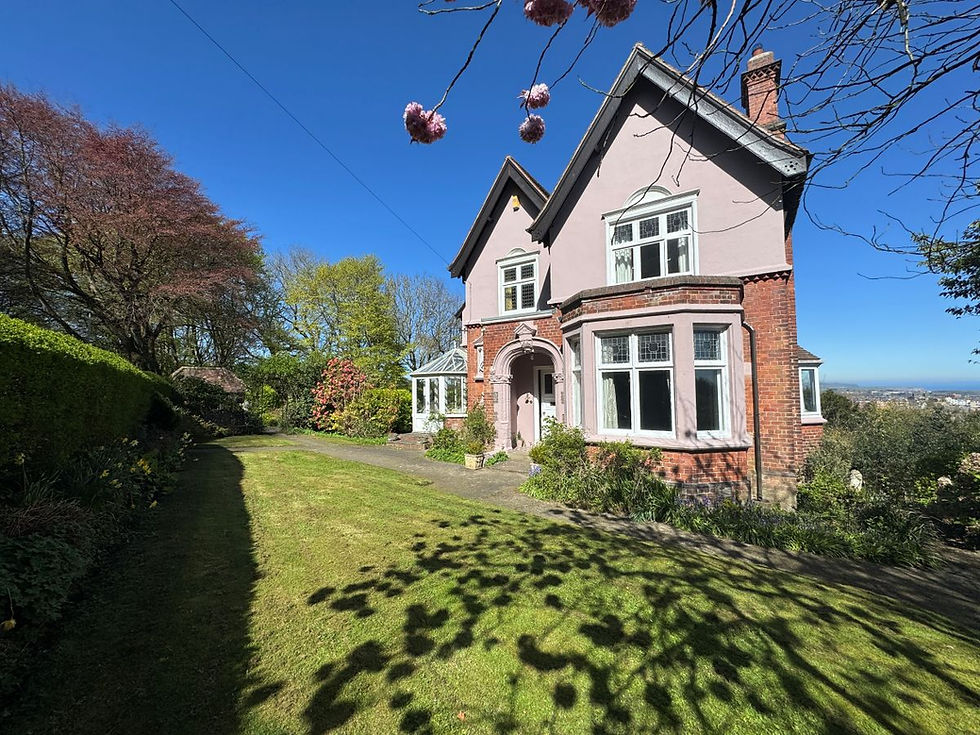
There is a particular satisfaction in surveying an older home. Beneath the decorative plasterwork, the leaded fanlights and the original timber staircases lies a building that was designed and constructed in a fundamentally different way from the houses we build today. Understanding that difference is the single most important thing a buyer of a period property can do, and getting it wrong can be expensive.
We were recently instructed to carry out a RICS Home Survey – Level 3, formerly known as a Level 3 Building Survey, on a substantial Edwardian detached home here in Scarborough. The property, dating from the early 1900s, sat on a sloping, wooded plot and retained much of its original character across three storeys, including basement accommodation. It was, in many ways, a lovely house. But it also illustrated almost every point we find ourselves making to buyers of traditional homes, so we wanted to share some of those lessons here.
Old walls work differently to new ones

Modern houses are built to keep water out using a cavity, a damp-proof course and impermeable materials. Most homes built before around 1919 do the opposite. Their solid masonry walls are designed to manage moisture rather than block it, absorbing a little rain and then releasing it back out as conditions dry. The traditional lime mortar and lime render used in these buildings are vapour-permeable, allowing moisture held within the wall to evaporate freely.
This matters enormously when it comes to repairs. A very common and very damaging mistake is to repoint or render a solid-wall property in modern cement. Cement is hard and impermeable, so instead of letting the wall dry out, it traps moisture inside the masonry. Over time, this can cause the brick faces to spall (flake away), accelerate frost damage, and push dampness inwards rather than allowing it to escape. The frustrating part is that this advice is often given in good faith by builders who simply aren't familiar with how traditional construction behaves.
Our guidance is always the same: where a solid-wall property needs repointing or rendering, use lime-based materials rather than cement. It is a question of working with the building and preserving the vapour permeability it depends on.
Level 3 - Building Survey, damp readings need interpreted, not just recorded
Buyers often expect a survey to deliver a simple verdict: "the house is damp" or "the house is dry". The reality is more nuanced, and this is where experience earns its keep.
In the Edwardian property we surveyed, most of the walls at ground and first floor recorded perfectly normal readings on our moisture meter. In the basement, however, readings were elevated. The instinctive reaction might be to declare rising or penetrating damp and recommend costly remedial work. But our thermal imaging and environmental analysis told a different story: the surface temperature of the basement walls and the dew point were almost identical, which is precisely the condition under which condensation forms. The likely culprit was therefore environmental, namely cooler below-ground surfaces, limited airflow and inconsistent heating, rather than water being drawn up through the structure.
The recommended fix in a case like this is not a chemical damp-proof course or tanking. It is better ventilation and more consistent background heat. Getting that diagnosis right can be the difference between a few hundred pounds of sensible management and several thousand pounds of unnecessary, and potentially harmful, intervention.
It is also worth knowing that a handheld meter only reads the surface few millimetres of a wall, and that old chimney breasts often show elevated readings simply because decades of coal fires left hygroscopic salts in the masonry that attract atmospheric moisture. A reading is a clue, not a conclusion.
Keep the air moving beneath the floors
Many period homes have suspended timber floors, ventilated by air bricks set into the external walls. Those air bricks are not decorative. They keep the void beneath the floor dry. When they become blocked, painted over, buried by raised ground levels or simply crumble away with age, airflow drops, moisture builds, and the floor timbers become vulnerable to decay. Replacing tired air bricks is a small, inexpensive job that protects a far more costly part of the building.
The roof tells you about the years ahead

The roof on this property received close attention. It was finished in traditional plain clay tiles and, like most roofs of its era, was built without any sarking felt or modern underlay beneath the tiles. In place of a membrane, the underside of the tiles had originally been torched, that is, bedded and pointed on the inside with lime mortar. This was the period method for steadying the tiles and resisting wind-driven rain and draughts, and it is a genuinely clever solution for its time. However, it is not the equivalent of a modern underlay, and the lime torching gradually loosens and detaches with age, as it had begun to do here.

The covering itself showed the wear you would expect of a roof of this age: a number of slipped, cracked and spalled tiles across the slopes, together with deteriorating mortar bedding to the ridges. Without a secondary membrane beneath them, any tile that slips, cracks or goes missing leaves the roof structure directly exposed to water ingress. The short-term need was therefore clear. Defective and missing tiles require replacement, and the ridge mortar needs re-bedding, but these are repairs to an ageing covering rather than a long-term cure.

Our advice in cases like this is straightforward. The slipped and missing tiles should be replaced, and the ridge mortar re-bedded now to keep the roof watertight. It is sensible to allow a budget for renewal in the long term. That said, a roof of this type can remain perfectly functional for many years, provided the covering is looked after, and the lime torching is maintained and reinstated where it detaches. Renewal is a long-term consideration rather than an imminent necessity, and when the time comes, it offers an opportunity to introduce a modern vapour-permeable underlay. Where work is needed, we are also happy to point clients towards suitable, properly qualified roofing contractors who understand traditional construction, so the repairs are carried out sympathetically and to the right standard.
Services and the paperwork
Period charm does not extend to wiring and boilers. Where electrical and gas installations have not been recently certified, we always recommend an up-to-date Electrical Installation Condition Report and current Gas Safe servicing before anyone commits to a purchase. These are not just boxes to tick. They protect your safety and your budget.
The takeaway for buyers
None of the findings above made the Edwardian home a bad buy. On the contrary, it was a characterful property performing broadly as it should for its age. The point is that a period home asks something different of its owner: an understanding of how it was built, a willingness to maintain it on a regular cycle, and the discipline to use the right materials and specialists.
That understanding is exactly what a Level 3 survey is for. It is the most detailed inspection RICS offers, and for an older, more complex building, it is, in our view, the only one worth having. A good report does not just list defects. It explains why they are happening, what they mean for you, and what to do about them.
How we are different

Most surveys follow the same pattern: an inspection, a report, and a single follow-up call. That is useful, but it treats the survey as the end of the relationship. We see it as the beginning.
Our service is designed to support you through the entire home-buying process, from the initial inspection right up to the moment the keys are turned in at the front door. Along the way, we will help you understand what the findings mean for your purchase, talk through the priorities, and work with you to identify suitable, competent and reputable local contractors, so the right work is carried out by the right people.
And it does not stop at completion. If something crops up a year or two down the line, we are still here for you. Put the kettle on, offer us a brew and a biscuit, and we will happily pop round to talk through any issues, whether that is in a few months or a couple of years' time.
That ongoing relationship is at the heart of how we work, and it is the part our clients tell us they value the most.
What our clients say
"I have moved house a few times and received the vague, ambiguous 'maybe a problem, maybe not' reports. Ricky is the surveyor of your dreams, like a detective of house integrity. Rather than just saying damp, he works out where the damp is coming from and how much of a problem it is. His depth of knowledge and attention to detail is incredible, and his aftercare has impressed me just as much. He phoned straight after the survey and has answered every follow-up question fully, with recommendations for solutions. I would use this company every time I move house. The best survey I have had." Verified Google review
Thinking of buying a period or traditionally built home in Scarborough or across North Yorkshire?

We specialise in Level 3 - RICS Home Surveys reports and have a particular interest in older, solid-wall and heritage properties. If you would like to discuss a survey, we would be glad to help.
If you are interested in a Level 3 - Home Survey, then please feel free to visit our Home Buyers Page.
Please also consider visiting our Book a Survey page, where you can see our availability and get a price quote for your new home survey. Thank you for reading this blog, and I hope you found it interesting!
Best wishes
Ricky Savage, Founder and Building Surveyor.


Comments